
How to Interpret Snake Tattoos: A Complete Guide
Nov
Snake tattoos carry deep meaning across cultures and time. In ancient Mesopotamia, they symbolized power and protection. The Egyptians used the uraeus to show royalty. In Greece and Rome, the Rod of Asclepius linked snakes to healing.
In South and East Asia, Nagas are revered in Hindu and Buddhist art. Mesoamerica’s Quetzalcoatl is a feathered serpent. These stories weave together the modern significance of snake tattoos.
Today, snake tattoos blend heritage with personal stories. They symbolize transformation and wisdom. The Ouroboros, for example, represents eternal life.
Some see danger and life in a snake’s curve. Styles like American Traditional and Japanese Irezumi influence how we view snake tattoos. Fine-line blackwork and realism also shape their meaning.
This guide answers, “What Do Snake Tattoos Symbolise?” It explores their meaning across cultures. It also looks at style, placement, and purpose. Our aim is to help you understand and choose a tattoo that tells your story.
Key Takeaways
- Snake tattoo symbolism draws on ancient sources from Egypt, Greece, India, and Mesoamerica.
- The interpretation of snake imagery in body art often centers on change, healing, and duality.
- What Do Snake Tattoos Symbolise? depends on culture, style, and personal intent.
- The meaning of snake tattoos shifts with design choices like American Traditional or Japanese Irezumi.
- Symbolic meanings behind snake tattoos include transformation, wisdom, protection, and renewal.
- Understanding context helps ensure a design that is respectful, authentic, and expressive.
The Cultural Significance of Snake Tattoos
Snakes have been important in human stories for a long time. They are found in royal courts and street art. Today, snake tattoos mix old stories with new meanings. They show power, renewal, and protection, while honoring the long history of serpents in tattoos.
Historical Context of Snake Imagery
In ancient Egypt, the uraeus on crowns showed divine rule and defense. In Greece, the serpent on Asclepius’s staff meant healing and medicine. Roman homes had serpents to guard the family.
The Ouroboros, seen in late Egyptian and Greek texts, symbolized eternity and cycles. These stories shape the meaning of snake tattoos today.
Snakes in Different Mythologies
In the Hebrew Bible, the serpent tempts in Genesis, but Moses’s bronze serpent heals. Norse myth has Jörmungandr as a world-encircling force. Across the Atlantic, Quetzalcoatl, the feathered serpent, links wisdom, wind, and creation.
In South Asia, Hindu Nagas are symbols of fertility, rain, and guardianship. In Buddhism, Mucalinda protects the Buddha, showing protection and calm. These stories add depth to snake tattoos and guide their meaning.
Regional Variations in Meaning
In Japan, Irezumi tattoos often feature snakes with peonies or skulls for protection, prosperity, and safe childbirth. In Polynesia, serpent motifs connect to protection and mana, with meanings changing by island and lineage.
In Western American Traditional, a coiled rattlesnake means vigilance and liberty, like the Gadsden flag. In Latin America, serpent motifs reflect Indigenous cosmologies and natural cycles. Many U.S. studios encourage clients to add context and respect sacred images, highlighting the cultural importance of snake tattoos.
| Culture/Region | Core Meaning | Common Motifs | Tattoo Implications |
|---|---|---|---|
| Ancient Egypt | Royal authority, protection | Uraeus, cobra | Power and guardianship in snake symbolism in tattoos |
| Greece & Rome | Healing, household safety | Staff of Asclepius, lararia serpents | Medical themes and protective wards in designs |
| Norse | Cosmic order, boundaries | Jörmungandr | Limit, fate, and cyclical balance |
| Mesoamerica | Wisdom, creation, wind | Quetzalcoatl | Knowledge and creative force in the cultural significance of snake tattoos |
| South Asia | Fertility, rain, guardianship | Nagas | Protection and life cycles in the significance of serpents in tattoo designs |
| Japan | Protection, prosperity | Snake with peony or skull | Safe childbirth and fortune motifs |
| United States | Vigilance, liberty | Coiled rattlesnake | “Don’t tread on me” ethos in snake symbolism in tattoos |
| Polynesia | Protection, mana | Lizard/serpent patterns | Respect for local meanings and lineage |
Common Symbolic Meanings of Snakes
In studios from New York to Los Angeles, artists see snakes in body art as complex yet clear. A snake’s coil might mean survival, while a simple line hints at change. The meaning often depends on culture, style, and the artist’s intent.
Design choices guide how viewers read the hidden meanings of snake tattoos. Different styles like fine-line, neo-traditional, or blackwork tell different stories. They can show renewal, protection, or insight.
Transformation and Rebirth
Snakes shed their skin, leading many to see them as symbols of fresh starts. This fits life changes like recovery, divorce, or starting a new career. The Ouroboros, a serpent eating its tail, adds a cycle of renewal.
Artists often pair moons or clocks with a serpent to mark time and change. These elements show motion, not stasis.
Protection and Healing
Snakes have long been seen as guardians and healers. They are found in ancient doorways and in modern hospitals. In the United States, emergency crews recognize the single-serpent staff as a medical emblem.
Coiled snakes are used by some military and biker groups to show vigilance. This theme blends watchfulness with strength.
Wisdom and Knowledge
In alchemy and esoteric art, serpents are seen as keepers of secrets. In Mesoamerican and Asian traditions, they are linked to learning, rain, and fields. This connects insight to the cycles of land and study.
Fine-line work with books, keys, or stars can hint at intellect. Placed near the forearm or collarbone, it reads as inquiry and poise. This aids in understanding snake tattoos.
| Theme | Core Idea | Iconic Motifs | Common Placements | Design Tips |
|---|---|---|---|---|
| Transformation & Rebirth | Life change and renewal | Ouroboros, shedding skin, crescent moon | Forearm wrap, ribcage, ankle | Use flowing lines and gradients to show motion |
| Protection & Healing | Defense and care | Rod of Asclepius, doorway coils, shield forms | Upper arm, chest, calf | Emphasize a single serpent and clear staff silhouette |
| Wisdom & Knowledge | Insight and study | Books, keys, stars, alchemical sigils | Collarbone, inner forearm, behind the ear | Fine-line detail with subtle dotwork for depth |
| Sub-Meanings | Sexuality, danger, duality, balance | Fangs, twin snakes, yin-yang cues | Spine, sternum, wrist | Contrast light and dark to clarify hidden meanings of snake tattoos |
- Sexuality and fertility can be shown with lush florals or entwined forms.
- Danger and survival appear in visible fangs or poised strikes.
- Temptation and duality draw from narrative lore, using mirrored snakes.
- Balance emerges in twin serpents arranged like a yin-yang.
Placement and style refine every snake tattoo interpretation. With balanced symbols and crisp linework, the piece can honor change, shield the wearer, or mark a path toward learning—all within the hidden meanings of snake tattoos.
Types of Snake Tattoos and Their Meanings
When you choose a snake tattoo, you’re picking a story. Artists use shapes, colors, and movement to tell your tale. Knowing what snakes mean in tattoos helps pick the right style and mood.
Popular Snake Species in Tattoos
Rattlesnakes are all about being alert and tough. Their rattle warns of danger, making them perfect for bold tattoos. Cobras, known from Indian and Southeast Asian art, symbolize power and safety with their hood.
Pythons and boas show strength and patience, often curled up. Coral snakes and kingsnakes use bright colors to warn, great for striking tattoos. Adders and vipers hint at danger and toughness. In Japan, the hebi snake is known for its intensity.
Traditional vs. Modern Designs
American Traditional tattoos feature bold lines and simple colors. They often pair snakes with symbols of courage and life. Japanese Irezumi tattoos show snakes in nature scenes, telling stories of the seasons.
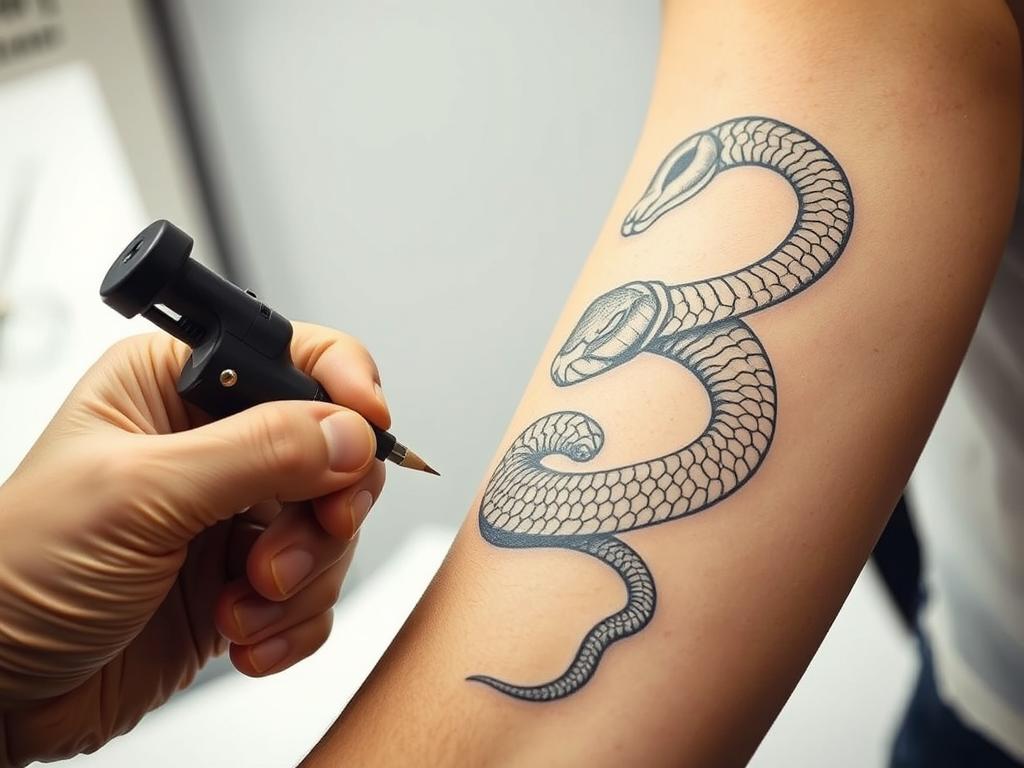
Neo-traditional tattoos add more colors and details for a rich look. Realism focuses on the snake’s appearance, like scales and eyes. Blackwork and geometric tattoos use patterns, while fine-line tattoos offer subtle beauty. Through all styles, the snake’s meaning remains strong, from danger to new beginnings.
Placement and Its Significance
Where you place your tattoo changes its message. Arms and legs show off the snake’s length and movement. The spine and ribcage highlight change, linking to the snake’s role in transformation.
Thighs and hips can add a sensual touch with their curves. Hands and necks make bold statements. Finger and behind-the-ear tattoos are more subtle. Tattoos on the collarbone or obliques make the snake’s shape clear from all sides.
Snake Tattoos in Popular Culture
Snake tattoos are everywhere, from streetwear to movies. They mix myth and fashion, making them popular across many scenes. This wide appeal shows how snake tattoos are seen in different ways.
Designs shift with context: a coiled snake can mean defiance, while a looped one suggests renewal. People quickly understand danger, wisdom, or allure from serpents in music, games, and movies.
Iconic Snake Tattoo Appearances
The Gadsden flag’s coiled snake is seen in tattoos and patches, showing independence and alertness. The Ouroboros, a snake eating its tail, is found in fantasy and sci-fi, symbolizing cycles and rebirth. Stylized cobras in martial arts and streetwear add to the snake’s meaning, showing speed, threat, and focus.
In movies and TV, snakes often mark characters as antiheroes, mentors, or mystics. This visual shorthand adds depth and intrigue to their stories.
Influential Celebrities with Snake Tattoos
Rihanna’s Medusa look brought serpents back into fashion, inspiring sleek designs. Cara Delevingne’s small tattoos started a trend for tiny, detailed snake art. Ruby Rose and Halsey kept the snake theme alive with their tattoos.
Pop stars like Zayn Malik and Justin Bieber have also used snake symbols in their fashion lines. This has made snake tattoos more popular among young people.
Representation in Art and Media
Damien Hirst’s work, featuring medical symbols, has reinterpreted the Rod of Asclepius for today’s audience. Gucci’s kingsnake design has become a symbol of luxury, making snake patterns popular in tattoo art.
Artists and designers play with the snake’s dual nature of temptation and wisdom. This keeps the symbolism of snake tattoos fresh and open to new interpretations.
| Pop Culture Driver | Typical Snake Motif | Core Signal | Design Trend | Impact on Meaning |
|---|---|---|---|---|
| Gadsden Flag Influence | Coiled rattlesnake | Autonomy, vigilance | Bold blackwork, banner text | Highlights civic edge within snake tattoo symbolism |
| Fantasy & Sci‑Fi | Ouroboros loop | Renewal, time cycles | Minimalist rings, dotwork | Expands the hidden meanings of snake tattoos toward philosophy |
| Martial Arts & Streetwear | Flared cobra hood | Speed, threat, focus | High-contrast neo-trad | Sharpens the representation of snake imagery in body art for action cues |
| Celebrity Influence | Fine-line serpent | Elegance, mystique | Micro tattoos, geometric forms | Normalizes subtle takes on snake tattoo symbolism |
| Contemporary Art & Fashion | Kingsnake, Rod of Asclepius | Luxury, healing, intellect | Red-black-white bands, medical icon | Broadens the hidden meanings of snake tattoos into health and status |
Emotional Representation of Snake Tattoos
Snake tattoos carry deep emotions. They symbolize fear, strength, and healing. This shows real change and clear intent.
Before choosing a design, artists often suggest journaling what you want the piece to say. Collect visuals and talk with your artist about tone and story. This makes the tattoo meaningful to you.
Personal Interpretations of Snake Imagery
Many turn fear into power with snake tattoos. A coiled viper can mark the day fear lost its grip. Others use them to show healing and renewal.
Some choose a poised cobra to signal boundaries. This communicates vigilance without words.
The Role of Snakes in Personal Stories
Story-driven designs include dates, birthstones, and hometown flora. A corn snake with wildflowers from Texas can hold memories and places.
Pairings add meaning: a snake with a chrysanthemum for resilience, or a lotus for rebirth. Each choice strengthens the tattoo’s message.
Why People Choose Snake Tattoos
Snakes are adaptable. They fit around the body, making them versatile. They carry cross-cultural weight, making the message timeless.
People mark sober anniversaries, career pivots, or spiritual turns with snake tattoos. These tattoos make complex identities easy to read.
| Emotional Goal | Design Cues | Pairings | Notes for Consultation |
|---|---|---|---|
| Overcoming Fear | Coiled, forward gaze, tense linework | Thorns, storm clouds, bold blacks | Define the moment fear shifted; align pose with stance |
| Healing and Renewal | Shedding skin, smooth gradients, soft edges | Lotus, water ripples, sunrise hues | Map milestones; place near scars to echo recovery |
| Boundaries and Protection | Raised hood, guarded coil, negative space | Chrysanthemum, shield shapes, geometric frames | Clarify what you protect; set scale to read from a distance |
| Identity and Change | Flowing body along muscles, directional movement | Birthstones, hometown flora, constellations | List dates or places; match species to theme and anatomy |
Designing Your Snake Tattoo
First, decide what story your tattoo will tell. Choose a snake tattoo symbolism that fits your style and how often you want to show it. Think about the movement, scale detail, and how the body part will show off the design.
Choosing the Right Style
American Traditional is great for bold, lasting designs. It uses thick lines and solid colors to keep scales sharp. Japanese Irezumi is perfect for a detailed sleeve, with sweeping coils and masks that honor snake symbolism.
Realism gives a photorealistic look, capturing the snake’s sheen and eyes. But, it needs more skin and careful placement. Blackwork or geometric designs create a minimalist, meditative vibe. Fine-line tattoos are elegant and discreet, ideal for wrists or ankles.
Color Symbolism in Snake Tattoos
Colors can change the mood and meaning of your tattoo. Green represents renewal and nature. Red shows passion, warning, or danger, like coral or kingsnake energy. Black and gray add mystery and elegance, fading slowly over time.
Gold accents suggest insight or luxury, while blue brings calm seas or mythic depth. Using fewer colors can make your tattoo last longer under sun and studio lights. Choose colors that match the snake symbolism you want, and test them on your skin.
Working with a Tattoo Artist
Look for portfolios with serpents, Irezumi, or realism. Make sure the artist is licensed and follows good hygiene. Discuss where to place the tattoo, how it will flow, and how body curves will guide the coils.
Ask for a stencil to check the wrap-around fit. Agree on line weights and scale textures. Confirm how many sessions it will take, the cost, and a healing plan. For a better experience, check their aftercare and pain-management approach via this about us resource, then set clear expectations before booking.
- Style cues: American Traditional, Japanese Irezumi, realism, blackwork/geometric, fine-line
- Color intent: green for renewal, red for warning, black/gray for elegance, gold for insight, blue for calm
- Fit and flow: stencil test, coil direction, scale size, and detail retention
- Logistics: license, hygiene, session plan, pricing transparency, touch-up terms
Maintenance and Aftercare of Snake Tattoos
Your new serpent design is special, whether it’s about the meaning of snake tattoos or the broader symbolism. Taking good care of it keeps the artwork looking sharp and vibrant.
Importance of Proper Aftercare
Follow your studio’s advice on using Saniderm. Wash with fragrance-free soap, pat dry, and apply a thin layer of ointment. Stay away from soaking, tight clothes, tanning beds, and direct sun while it heals.
Good aftercare keeps your tattoo looking great. It ensures the fine details and colors stay sharp. Early care also helps prevent scabs that can ruin the tattoo’s look.
Tips for Longevity of Tattoo Design
- Use SPF 30+ daily to prevent fading and keep the tattoo bold.
- Moisturize to keep the skin elastic, helping the tattoo stay smooth.
- Plan touch-ups as needed to refresh the tattoo without harming the skin.
- Avoid sudden weight changes to prevent stretching and distorting the tattoo.
- Talk to your artist about durable line weights and contrast to keep the tattoo’s meaning clear over time.
Common Issues with Snake Tattoos
Blowouts can happen on thin skin like fingers and wrists. Handle it gently to reduce risk. Avoid overworking small scales to prevent blurring.
Wrap-around designs need careful planning to avoid misalignment. Some colors, like certain reds, can cause allergies. Ask for a patch test. If you get keloids, discuss safer options with your artist to protect your tattoo.
Conclusion: The Enduring Fascination with Snake Tattoos
Snake tattoos have been a part of American body art for a long time. They go back to ancient myths and are loved today in tattoo studios. These tattoos symbolize strength, change, and focus, answering the question of what they mean.
Recap of Key Meanings
Snakes represent transformation and rebirth, as well as protection and healing. They also stand for wisdom and knowledge. The meaning can change based on the culture, the type of snake, and how it’s designed.
For example, a snake tattoo on the wrist can mean something different than one on the arm. This variety makes snake tattoos special for people all over the U.S.
Future Trends in Snake Tattoo Designs
Expect to see more detailed snake tattoos with fine lines and soft shading. These designs will look good for years to come. You’ll also see new ideas like snakes mixed with geometric patterns.
Artists are using eco-friendly inks and telling stories in their work. The fashion world’s love for snake designs will influence new styles. This will help snake tattoos keep their symbolic meanings fresh and exciting.
Personal Reflection on Choosing a Snake Tattoo
What Do Snake Tattoos Symbolise? The answer is personal. Think about why you want one and when. Pick an artist who knows about snakes.
Choose colors and designs that mean something to you. This way, your tattoo will be meaningful now and in the future. In the U.S., a snake tattoo can be a powerful symbol of wisdom, protection, and renewal.